How to Draw Lace, Tulle, and Sheer Fabrics in Fashion Illustration: Layers, Transparency, and Delicate Detail
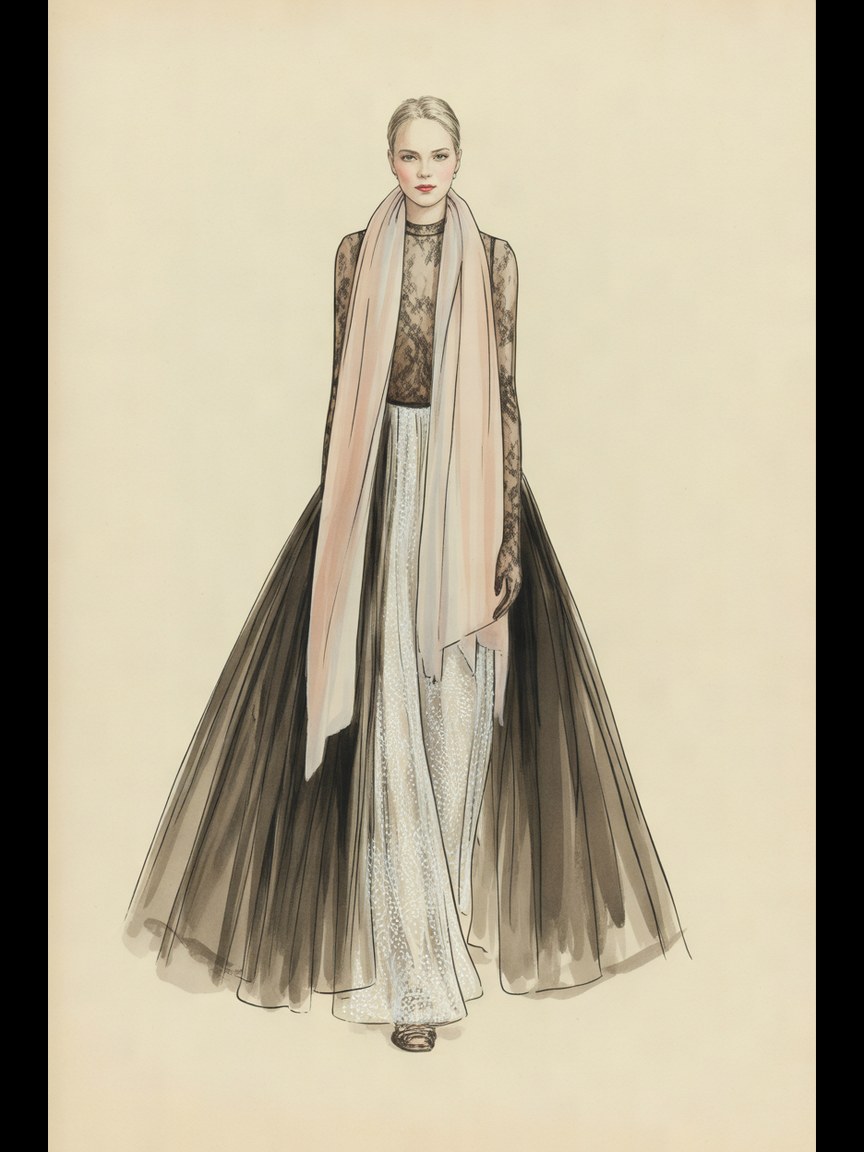
Sheer fabrics look impossible until you realize you are not drawing the fabric at all. You are drawing what you can see through it. Lace, tulle, organza, and chiffon are defined by the layers they sit on, so the secret is to build from the inside out.
Holiday party season is the perfect time to practice. Evening wear leans on lace sleeves, tulle skirts, and chiffon wraps, and each one asks for a lighter hand than the cotton, denim, or leather you may have been drawing lately. The good news is that the same few principles cover all of them.
Draw What Is Underneath First
A sheer layer never hides the body or the garment beneath it. It only softens it. So start with the figure, the slip, the lining, or the skin tone, and finish that part completely. Only then do you add the transparent layer on top. If you paint the sheer fabric first, you will end up trying to cut a window into it later, and the result always looks muddy.
Use a light figure template for this stage so your underlying pose stays accurate. If proportions are a weak spot, our 9-head proportion guide covers the basics.
Think in Layers and Values
Transparency is a value trick. Where a sheer layer overlaps skin, the skin tone dims slightly. Where it overlaps a darker fabric, the dark softens a touch and picks up the sheer fabric's own tint. Three rules keep this believable:
- Keep overlaps only a step or two different. The area seen through the sheer layer should be just slightly different from the same area uncovered.
- Let edges and folds carry the fabric. A sheer layer is most visible where it doubles over itself, at hems, gathers, and folds, because two thicknesses stack up to a deeper tone.
- Use light washes. Build with thin transparent layers rather than one heavy coat. For a refresher on controlling tone, see our color theory guide.
Drawing Tulle and Organza
Tulle is a fine net that stands away from the body, so a tulle skirt is mostly about volume and soft, many-layered folds. Organza is crisper and holds sharper shapes.
- Draw the silhouette first, and decide how full it is. Tulle skirts flare out in long, gentle cones.
- Lay a pale, even wash for the base color, then let it dry.
- Add long, loose vertical strokes to suggest overlapping layers. Let some of them be darker where the layers stack and nearly empty where the skirt thins out.
- Finish the hem with a few thin, slightly wobbly lines. A perfectly even hem looks like plastic.
A black tulle skirt over a light slip, as in the image above, is a good exercise. The dark net should deepen toward the hem while the lighter layer shows through the upper area.
Drawing Chiffon and Georgette
Chiffon is the lightest and most fluid of the group. It floats, and it catches the air. Draw it with long curving lines that follow the direction of movement, and keep the edges soft and uneven. A chiffon scarf or sleeve needs very little detail. A few confident gradient washes and a handful of thin contour lines are enough. For more on how fabric travels, read our guide to drawing movement and fabric flow.
Drawing Lace Without Drawing Every Thread
Lace scares people because of the pattern. The trick is to suggest it rather than copy it. Real lace is dense, and no one expects to see every loop in a sketch.
- Block in the dark shape first. Lay a flat tone for the lace, or paint the skin tone behind it.
- Add a few motifs. Draw flowers, leaves, or scrolls with a fine pen, clustered in some areas and thinning in others.
- Follow the body. Pattern shapes should curve and shrink as the form turns away, just like any print. Our guide to drawing prints and patterns goes deeper on this.
- Draw the scalloped edge. A scalloped hem or cuff is the quickest way to say lace. A row of small repeated arcs does a lot of work.
- Fade it out. Detail the lace near the focal point, then let it dissolve into plain tone toward the edges of the garment.
Common Mistakes With Sheer Fabrics
- Outlining the body through the fabric as a hard line. Use a softer tone so the layer feels like it sits in front.
- Making the sheer layer too opaque. If you cannot see the layer below, it reads as solid cloth.
- Over-detailing lace. Too many thin lines turn into gray noise. Edit hard.
- Using the same color for every layer. A slight tint shift between layers sells the depth.
- Heavy, even edges. Delicate fabrics need a variable, light line.
A Fifteen-Minute Layer Drill
Draw one simple dress shape on a figure template and color it a solid mid-tone. Then draw a second version and cover only the skirt with a very light tulle wash and a hem line. Finally, add a lace sleeve using just a flat tint, five or six motifs, and a scalloped cuff. Compare the three. You will see how little it takes to make fabric look weightless.
Recommended Supplies for Drawing Sheer Fabrics
For Soft Layered Washes
Copic Sketch Markers (72-color set) layer in pale, transparent tones that suit tulle and chiffon.
For Lace Motifs
Sakura Pigma Micron Set (6 pens) gives you fine, consistent lines for lace flowers and scalloped edges.
For Gentle Shading
Prismacolor Premier Colored Pencils (72-set) let you build soft shadow where layers overlap.
For Reliable Paper
Canson XL Mix Media Pad handles light washes, pen, and pencil without buckling.
Practice Layering on Ready-Made Figures
Our Fashion Croquis Template Sketchbook: Paris Edition gives you 300 pages of light grey 9-head figure templates with scenic Paris backgrounds. Trace the figure, then dress it in lace and tulle.
Get the Paris EditionSome links above are affiliate links. If you purchase through them, we may earn a small commission at no extra cost to you. We only recommend products we genuinely use or believe in.