Drawing Dynamic Movement: How to Capture Flow and Draping in Fashion Illustration
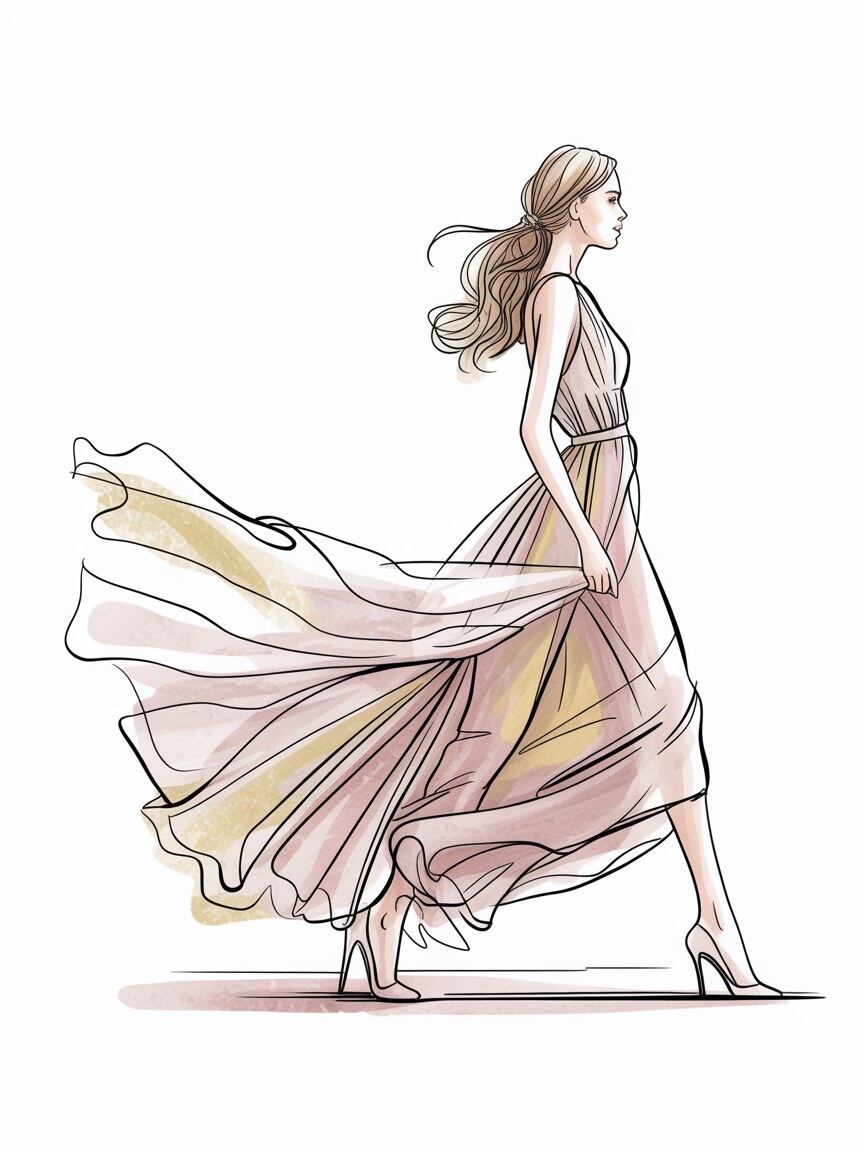
A static figure in a beautiful garment is fine. But a figure in motion, with fabric catching air, hems swinging, and scarves trailing? That's when a fashion illustration stops being a flat sketch and starts telling a story. Movement is what separates competent technical drawing from illustration that makes people feel something.
The problem is that movement is hard. Unlike structure (which you can study in a mirror) or texture (which you can render from a swatch), movement is fleeting. You can't pause it, hold it up to the light, or measure it with a ruler. You have to understand why fabric moves the way it does, then translate that understanding into marks on paper.
That's exactly what this guide covers. By the end, you'll know how to draw garments that look like they're mid-motion, even on a completely still page.
The Line of Action: Movement Starts Before the Clothes
Before a single fold or flutter gets drawn, movement has to live in the figure itself. The most beautifully rendered flowing skirt in the world will look wrong on a stiff, upright mannequin.
The line of action is an imaginary curve that runs through the core of your figure, from the top of the head down through the torso and into the weight-bearing leg. It's the first mark you should make when drawing a figure in motion.
How it works:
- A straight vertical line = static. The figure is standing at attention. There's no energy here.
- A gentle S-curve = contrapposto. Weight shifted to one hip, shoulders tilted opposite. This is fashion illustration's bread and butter. Most croquis templates use some version of this. (If you need a refresher, see our 9-head proportion guide.)
- A deep C-curve or dramatic S = active movement. The figure is walking, twisting, reaching, or leaning. This is where garments really start to react.
The rule: The more dramatic the line of action, the more dramatic the fabric response will be. A figure mid-stride generates more fabric movement than a figure shifting weight. A figure caught in a spin generates more than a figure mid-stride. Match your fabric energy to your figure energy.
Try this quick exercise:
Draw five lines of action on a page, each progressively more curved and dynamic. Then, without drawing any features or details, rough in a simple tube dress on each one. Notice how even a basic garment shape starts to look more alive as the underlying curve gets bolder. That's the line of action doing its job.
The Three Forces That Move Fabric
Every fold, flutter, and drape you'll ever draw comes from three forces working on fabric. Understand these three, and you can draw movement from imagination instead of always needing photo reference.
1. Gravity
Fabric falls straight down unless something stops it. That "something" is usually the body underneath, a belt, a seam, or another piece of fabric. Gravity creates vertical folds and hanging drapes.
- A skirt hanging from the waist falls in vertical folds toward the floor.
- A cape draped from the shoulders creates long, sweeping V-shaped folds between the attachment points.
- Heavier fabric (wool, velvet) falls more directly and with fewer folds. Lighter fabric (chiffon, silk) falls with more undulation and layered folds.
Drawing tip: When in doubt about where a fold goes, ask yourself: "Where is this fabric attached, and where is straight down from there?" Draw a light vertical guideline from each attachment point. The fabric will always tend toward those verticals.
2. Tension
Tension happens when fabric is pulled between two points. Think of a fitted bodice pulled taut across the chest, or a pencil skirt stretched across the knees during a stride. Tension creates diagonal pull lines that radiate from the point of stretch.
- A bent elbow creates tension folds that fan out from the inner elbow crease.
- A walking leg pulls the fabric of a narrow skirt diagonally from the knee toward the opposite hip.
- A hand in a pocket pulls the fabric of a jacket diagonally toward the pocket opening.
Drawing tip: Tension lines are always straight or slightly curved, never wavy. They point from the area of stretch toward the nearest anchor point (seam, waistband, button). If your tension folds are wavy, something's wrong.
3. Compression
Compression is the opposite of tension. It happens where fabric bunches up because there's more material than space. Think of fabric pooling at the ankles of too-long trousers, or gathering at the waist of a cinched dress. Compression creates clustered, rounded folds.
- The inside of a bent arm collects compressed folds at the elbow.
- A floor-length gown pools and compresses at the feet.
- Gathered or ruched fabric is compression by design.
Drawing tip: Compression folds are short, bunched, and overlapping. Draw them as nested curves, like parentheses stacked inside each other. The more excess fabric, the more compressed folds you draw.
Drawing Wind-Blown Garments
Wind is the most dramatic (and most fun) movement to illustrate. A figure standing in a breeze, with a skirt catching air and hair trailing, is one of fashion illustration's most iconic images.
Wind adds a horizontal force to gravity's vertical pull. The result is fabric that moves diagonally, trailing behind the figure or billowing to one side.
Rules of wind in illustration:
- Everything moves in the same direction. If the wind is blowing left to right, hair, hems, scarves, sashes, and loose fabric all trail to the right. Nothing blows backward against the wind.
- Anchored fabric resists more than free fabric. A fitted sleeve barely reacts to wind. A loose chiffon overlay catches it fully. The more structure and attachment a garment has, the less wind affects it.
- Show the body underneath. Wind pressing fabric against the body reveals the figure's shape. On the windward side, the fabric will cling to legs, hips, and torso. On the lee side (away from wind), the fabric lifts and billows.
- Edges are where the action happens. Hems, cuffs, collars, and any open edge of a garment will react most visibly to wind. Focus your energy on drawing these edges with movement rather than trying to animate the entire garment.
A simple wind exercise:
Draw a standing figure in a simple A-line dress. Now redraw it three times:
- Light breeze: The hem shifts slightly to one side. Hair lifts a bit. Barely noticeable unless you're looking.
- Moderate wind: The skirt presses against the front leg and billows behind. Hair streams to one side. Scarf or sash trails horizontally.
- Dramatic gust: The skirt wraps around the front leg and lifts high on the opposite side. Hair flies. Every loose element reacts. This is your "editorial illustration" level of drama.
Compare the three. Notice how increasing the wind intensity is really about increasing the angle of the trailing elements. Light breeze = nearly vertical. Dramatic gust = nearly horizontal.
The Runway Walk: Capturing the Stride
Runway walking is the single most common movement in fashion illustration, and most artists get it subtly wrong. The issue is that a runway walk is not a normal walk. It's longer, more deliberate, and more exaggerated.
What makes a runway walk different:
- Longer stride. Models take bigger steps than normal walking. The feet are placed further apart.
- Crossover foot placement. Models walk with one foot crossing slightly in front of the other (the "one line" walk), which creates an exaggerated hip sway.
- Opposite arm swing. The right arm swings forward when the left leg steps forward, and vice versa. This creates a natural twist in the torso.
- Forward lean. There's a slight forward lean from the ankles, like the figure is cutting through air. This is subtle but critical for energy.
How the garment responds to a runway stride:
- Skirts and dresses swing opposite to the leading leg. If the left leg steps forward, the skirt hem trails slightly to the right and back.
- Split or slit garments open to reveal the stepping leg. This is one of fashion's most iconic visual moments, and it's all about drawing the gap between the fabric edges correctly.
- Jackets and coats open at the front as the arms swing. The front panels separate, revealing what's underneath. The back may kick up slightly with each step.
- Scarves, belts, and accessories trail behind the direction of motion, just like wind. A long necklace will swing forward with each step, then settle back.
Pro tip: Study runway videos in slow motion. Platforms like YouTube have thousands of runway clips. Pause at the moment of maximum stride (when both feet are farthest apart) and sketch the figure and fabric positions quickly. Five minutes of this will teach you more about movement than an hour of reading.
Drawing Specific Draping Scenarios
Let's get practical. Here are five common draping situations you'll encounter in fashion illustration, with specific guidance for each.
1. The Flowing Maxi Skirt
A floor-length skirt in lightweight fabric (chiffon, georgette, crepe de chine) is all about gravity and air resistance. The fabric falls from the waist in vertical folds, but any body movement disrupts the fall and creates diagonal lines.
- Draw the waistline as your anchor. All folds originate here.
- Use long, sweeping lines from waist to hem. These should curve, not zigzag.
- The front of the skirt, closest to the legs, will show the body's shape through the fabric. Draw subtle indications of the knees and thighs pressing against the material.
- The sides and back of the skirt flow more freely. Let your lines loosen here.
2. The Off-Shoulder Drape
Cowl necks, off-shoulder tops, and draped bodices are held by gravity and the body's curves. The fabric hangs from the shoulders (or wherever it's attached) and creates catenary curves, the same shape as a chain hanging between two posts.
- Identify the two attachment points (usually the shoulder tips or the sides of a neckline).
- Draw a gentle U-shaped curve between those points. This is the primary drape.
- Below the primary drape, the fabric falls in secondary folds toward the body. These are narrower and more vertical.
- The depth of the U depends on how much excess fabric exists. A tight cowl has a shallow U. A generous drape has a deep one.
3. The Trailing Hem or Train
A train, whether on a gown, a coat, or a bridal piece, follows the figure's path. It's essentially a fabric record of where the body has been.
- The train connects to the figure at the waist or hips and trails behind, following the floor.
- If the figure has just turned, the train will curve. If walking straight, it trails straight back.
- The edges of the train are the most visually interesting part. Draw them with gentle waves, not straight lines. Even the heaviest fabric has subtle undulation at its edges.
- Shadow the area where the train contacts the floor. This grounds it and prevents it from looking like it's floating.
4. The Twist and Wrap
Wrapped garments (sarongs, wrap dresses, toga-style draping) follow a spiral path around the body. The fabric crosses over itself, creating overlapping layers that are intimidating but follow a simple logic.
- Follow the fabric's path from its starting point (usually one shoulder or one hip) as it wraps around the body.
- Where the fabric crosses over itself, the top layer casts a shadow on the layer below. Always indicate this overlap with a shadow line.
- The fabric tightens where it wraps closest to the body and loosens where it falls away. Alternate between tension lines (tight) and gravity folds (loose).
5. The Sleeve in Motion
Arms move constantly, and sleeves respond to every gesture. A raised arm, a hand on the hip, an arm swinging mid-walk: each creates a different set of folds.
- Raised arm: The fabric pulls upward from the shoulder and bunches at the armpit. Tension folds radiate from the underarm toward the wrist.
- Bent elbow: Compression folds gather at the inner elbow. Tension folds stretch across the outer elbow. This push-pull is what makes bent-arm sleeves interesting to draw.
- Arm at side: The sleeve hangs with minimal tension. Gravity dominates, creating a few soft vertical folds from shoulder to cuff.
- Bell or trumpet sleeves: These are gravity-dominated. The flared fabric falls in a cone shape from the elbow or wrist, with the widest folds at the opening. Perfect for showing movement because even small gestures make them swing.
Line Quality and Speed: How Your Mark-Making Creates Movement
Here's something that trips up intermediate illustrators: you can draw the correct fold structure and still have an illustration that looks static. That's because movement isn't just about what you draw. It's about how you draw it.
Techniques that sell movement:
- Vary your line weight dramatically. The leading edge of a moving garment (the side moving into space) should be drawn with a heavier line. The trailing edge (the side the garment is moving away from) should be lighter, even broken. This weight difference creates a sense of direction.
- Use long, unbroken strokes for flowing fabric. Don't build a flowing skirt out of short, hesitant marks. One long, confident curve says "movement" in a way that twenty short strokes never will. Practice drawing sweeping lines from your shoulder, not your wrist.
- Break the silhouette. A perfectly contained outline looks still. Let hem edges, scarf ends, or hair tips extend beyond the expected boundary of the figure. These breakaway elements are visual signals that something is in motion.
- Leave strategic gaps. Not every fold needs to be fully rendered. Leaving parts of a flowing garment unfinished (just the suggestion of a fold, the start of a curve that trails off) creates an impression of speed. The eye fills in what you leave out, and that act of completion feels dynamic.
Best tool for fluid line work: A Sakura Pigma Micron in a medium size (05 or 08) for consistent flowing lines, or a brush pen like a Tombow Dual Brush if you want natural line weight variation without lifting the pen. The flexible brush tip responds to pressure changes, making it ideal for the thick-to-thin transitions that sell movement.
Common Movement Mistakes (and How to Fix Them)
- Symmetrical folds on a moving figure. If your figure is walking, the garment response should be asymmetrical. One side stretches, the other compresses. Symmetry = stillness.
- Too many fold lines. Fabric in motion simplifies. Wind pulls fabric into a few large shapes, not a dozen small wrinkles. Resist the urge to fill every surface with folds. In movement, less is always more.
- The floating hem. If fabric is airborne (lifted by wind or a spin), it still needs to connect logically to the body at its attachment point. Follow the fabric from the waistband or seam upward and outward. Don't just draw a floating shape near the figure.
- Static hair on a moving body. If the body is in motion and the garments are responding, the hair should respond too. Forgetting to animate the hair is the fastest way to undermine an otherwise dynamic illustration.
- Mixing movement directions. If wind blows right, everything goes right. If the figure walks left, trailing elements go right. Pick your forces and commit. Contradictory movement reads as confusion, not dynamism.
Practice Exercise: The Same Dress, Five Movements
This exercise will cement everything in this article. Grab your sketchbook and draw a single garment design: a simple wrap dress with a midi-length skirt and a sash at the waist.
Now draw the same dress on five different figures, each in a different state of movement:
- Standing still. Gravity only. The skirt hangs vertically. The sash hangs at the side. Minimal folds.
- Walking forward. The skirt opens at the front wrap. One leg visible through the slit. Sash swings opposite to the stride. Subtle hip rotation.
- Turning to look over one shoulder. The torso twists, and the skirt wraps around the figure. Tension folds spiral from the waist. The sash catches the rotation and trails behind the turn.
- Caught in a gust of wind. Skirt presses against the front and billows behind. Sash streams horizontally. Hair flies. The fabric reveals the figure's shape on the windward side.
- Mid-spin. The skirt lifts and fans out in a cone shape around the figure. The sash extends outward centrifugally. Everything radiates from the center of rotation.
If you do this exercise honestly, you will have drawn more meaningful fabric movement in thirty minutes than most students draw in a semester. The key is that it forces you to think about the cause of the movement, not just copy the effect.
Recommended Supplies for Drawing Movement
For Fluid Line Work
Tombow Dual Brush Pens (10-pack) give you thick-to-thin variation in a single stroke. The flexible brush tip is perfect for sweeping fabric lines that taper at the edges.
For Clean Contours
Sakura Pigma Micron Set (6 pens) in graduated sizes lets you switch between bold silhouette lines and delicate interior fold details without changing tools.
For Preliminary Sketching
Prismacolor Col-Erase Pencils (24-pack) are the industry standard for fashion under-drawing. The light, erasable marks let you work out your line of action and fold map before committing to ink.
For Tonal Rendering
Copic Sketch Markers (72-color) let you build up transparent layers of shadow that follow the direction of your folds. Apply along the fold line, not across it, to reinforce the sense of direction.
Practice on Professional Templates
Our Fashion Croquis Template Sketchbook: Paris Edition includes walking and contrapposto figures with scenic Paris backgrounds. Sketch flowing garments directly over the light grey templates to practice draping and movement.
Get the Paris EditionSome links above are affiliate links. If you purchase through them, we may earn a small commission at no extra cost to you. We only recommend products we genuinely use or believe in.