How to Draw Knitwear and Sweaters in Fashion Illustration: Cables, Ribbing, and Chunky Texture
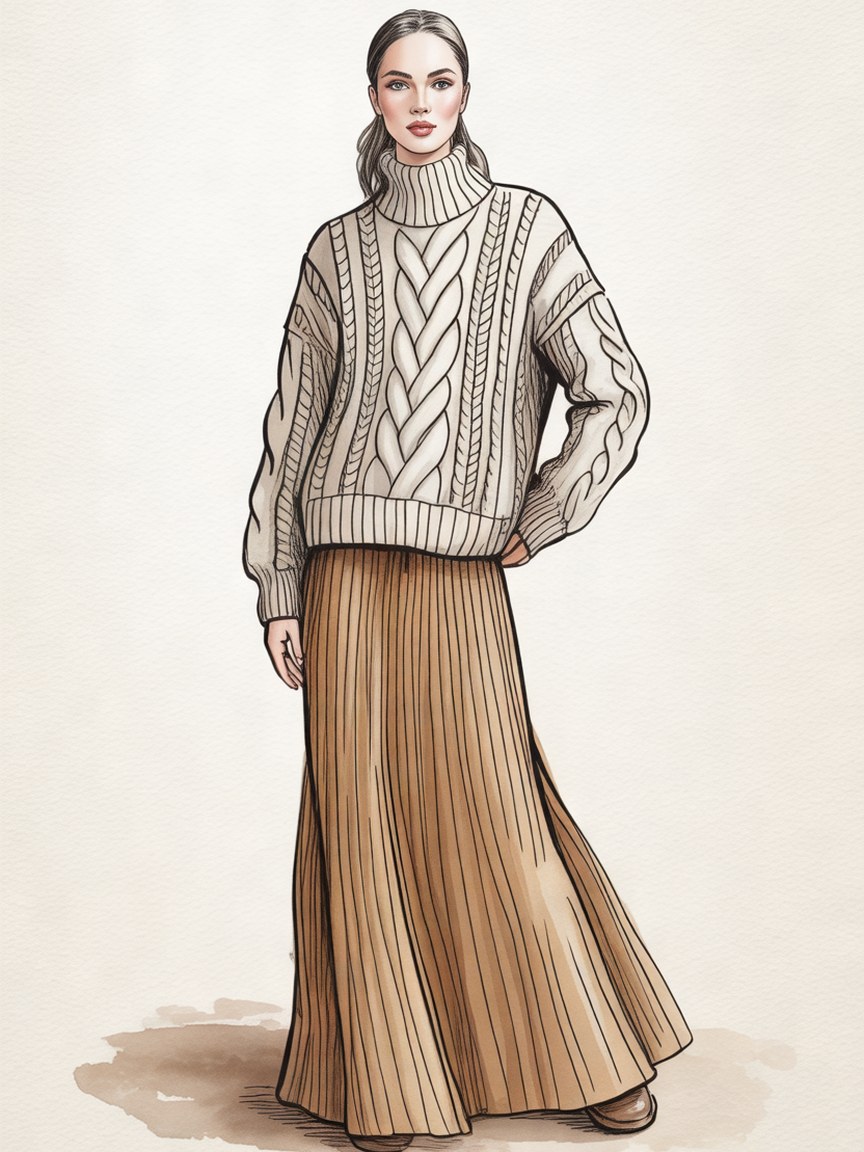
Knitwear is the quiet test of a fashion illustrator. A sweater has no hard seams to lean on and no crisp tailoring, just soft volume, texture, and the feeling of warmth. The secret is to draw the shape of the yarn, not every stitch of it.
Knit fabric is made from looped yarn rather than woven threads, which is why it stretches, drapes heavily, and holds the shape of the body underneath. A fine merino pullover hugs the torso. A chunky fisherman knit stands away from it in thick, rounded masses. Learning to see which one you are drawing is the first step.
Decide the Gauge First
Gauge is how thick the yarn and stitches are, and it controls almost every drawing choice you make:
- Fine gauge (merino, cashmere, jersey knit): smooth surface, small soft folds, close fit. Suggest texture with a few fine lines at the cuffs and hem.
- Medium gauge (classic crewneck, ribbed cardigan): visible rib lines, moderate folds, some volume at the sleeve.
- Chunky gauge (cable knit, aran, oversized wool): thick rounded shapes, deep soft shadows, and bold stitch patterns that become the main feature.
Build the figure first. If you need a refresher, our 9-head proportion guide shows where the shoulders, bust, and hips sit, and that matters even more under bulky knits, because the silhouette is all you have to show the body is there.
Draw the Silhouette as Soft Volume
Knitwear folds are rounded, not sharp. Where denim breaks, a sweater slumps. Keep your outer contour line slightly wavy, with gentle bulges at the elbow, the cuff, and the hem where the fabric gathers. Oversized sweaters drop at the shoulder, so place the seam well below the shoulder point, and let the sleeve bunch in soft horizontal folds toward the wrist.
Weight matters too. Heavy knits pull downward, so show the hem sagging a little and the neckline resting in a heavy curve. For how fabric moves with the body, see our guide to drawing movement and fabric flow.
Ribbing: The Easiest Win
Ribbing appears at the neckline, cuffs, and hem of almost every knit, and it is the fastest way to make a sweater read as knitwear. Draw it as evenly spaced vertical lines that follow the curve of the edge. At the cuff the lines should wrap around the wrist, bending with the form. A band that is slightly narrower than the body of the sweater creates the pinch where the knit gathers above it.
How to Draw Cable Knit
Cables look complicated, but they are repeating shapes. Break one down like this:
- Mark the columns. Draw light vertical guidelines to divide the front into cable panels and plain stitch panels.
- Draw the twist. A classic cable is a braid: two S-shaped strands crossing over each other. Sketch it as a chain of elongated ovals, each overlapping the one before.
- Add the outlines. Darken the edges where one strand passes over another, so the braid appears to rise off the surface.
- Fade it out. Let the pattern lose detail toward the shadow side and the edges of the garment. Detail everywhere looks flat. Detail in the light looks real.
Remember that cables pull the fabric inward, so a cabled sweater is slightly narrower and thicker than a plain one. Curve the cable lines with the body, bending around the bust and tapering at the waist rather than running ruler straight.
Suggest Texture, Do Not Count Stitches
The most common mistake is trying to draw every loop. It makes the drawing stiff and takes hours. Instead, use a few repeating marks in the lit areas: small V shapes for stockinette, short dashes for a moss stitch, or loose scribbled loops for a boucle. Then let those marks dissolve into plain color in the shadows. Our post on fabric textures in fashion illustration covers this shorthand for other materials as well.
A tip for fuzzy mohair
Mohair and brushed wool have a halo of fibers. Paint the shape flat and soft, then add tiny feathered strokes along the outer edge with a fine pencil, and keep the contour broken rather than solid. The fuzz is in the edge, not the middle.
Color and Shadow in Knit
Knits absorb light, so their color is rich but matte. Avoid hard white highlights. Instead, leave areas of lighter paper showing and build shadow in two soft steps: a mid-tone in the folds under the arm and along the hem, then a deeper tone only in the deepest crevices. Stitches themselves cast tiny shadows, so a line of slightly darker color beside each cable gives it depth. If you are choosing a palette for a cozy autumn collection, our color theory guide explains how warm neutrals and rich earth tones work together.
Common Knitwear Mistakes
- Sharp, stiff folds. Knits slump and bunch. Use rounded shapes.
- Drawing every stitch. Suggest, then fade.
- Forgetting the body. Even oversized knits hang from the shoulders and bend at the elbow.
- Ribbing that stays flat. Make the lines curve around the wrist and waist.
- No weight. Heavy yarn sags. Let the hem and cuffs drop.
A Cozy Practice Drill
Take the thickest sweater you own and hang it over a chair. Spend ten minutes drawing only its outer shape and where it folds. Then spend ten more adding ribbing and a single cable panel. Finally, draw it again on a croquis figure. Doing the same garment three ways teaches you how knit volume sits on a body better than any reference photo.
Recommended Supplies for Drawing Knitwear
For Soft Color Blending
Copic Sketch Markers (72-color set) include a full range of blues and a colorless blender, perfect for building soft, matte wool tones.
For Stitch Details
Sakura Pigma Micron Set (6 pens) gives you a fine tip for ribbing lines, cable outlines, and fine stitch marks.
For Colored Pencil Rendering
Prismacolor Premier Colored Pencils (72-set) let you layer warm neutrals and add fuzzy, feathered texture to wool.
For Paper That Handles Layers
Canson XL Mix Media Pad is sturdy enough for marker, pencil, and light washes without buckling.
Practice Knitwear on Ready-Made Figures
Our Fashion Croquis Template Sketchbook: Paris Edition gives you 300 pages of light grey 9-head figure templates with scenic Paris backgrounds. Trace the figure, then dress it in your coziest sweater.
Get the Paris EditionSome links above are affiliate links. If you purchase through them, we may earn a small commission at no extra cost to you. We only recommend products we genuinely use or believe in.